Last reviewed: May 2026
The short answer: right now
The moment your puppy comes home, training begins. Not formal, structured sessions with commands and repetitions, but the everyday interactions that teach your puppy how the world works, what gets rewarded, and what the rules are in your household. Every time you interact with your puppy, they are learning something. But the question is not whether to start training, but whether you are going to be intentional about what they learn.
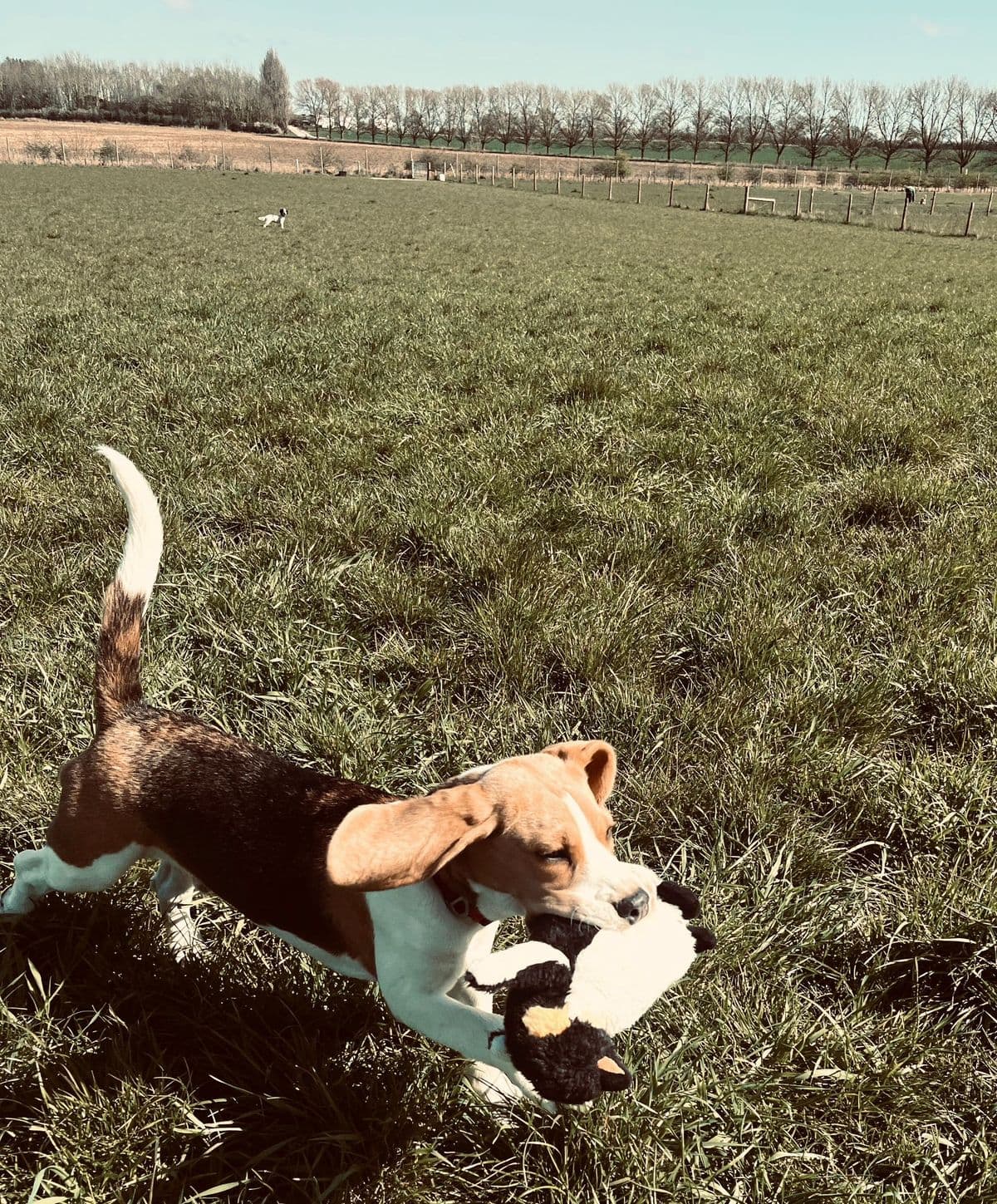
The old advice to wait until a puppy is six months old before starting training is thoroughly outdated and has been for decades. And it was based on methods that relied on physical aversive techniques, which genuinely should not be applied to a young puppy. Modern reward-based training is safe, effective, and appropriate from the day your puppy arrives. Waiting six months means missing the most receptive learning period of your puppy's life and allowing six months of habits (good and bad) to develop unchecked. Especially in winter.
8 to 10 weeks: the foundation
Your puppy has just left their mum and littermates. Timing matters. Everything is new. But the priority at this age is building trust, establishing routine, and starting the simplest foundations that everything else will build on.
A Labrador in our day care recently went from pulling his owner down the street to walking calmly beside her. His trainer used the same methods we recommend.
What to teach
Their name: Say your puppy's name in a happy tone. When they look at you, mark it (with a word like "yes" or a clicker) and give a treat. Repeat this dozens of times a day in different rooms and situations. Within a few days, your puppy should snap their head towards you when they hear their name. That's the foundation of attention and recall.
Toilet training: Take your puppy outside to the same spot after every meal, every nap, every play session, and every time they sniff the ground in circles. When they go in the right place, reward immediately with treats and praise. When accidents happen indoors (and they will), clean up without fuss. Never scold a puppy for toileting in the wrong place. They are not being naughty; they are being a baby who has not yet learned the rules.
Crate or bed as a safe space: Introduce the crate or bed as a wonderful place where good things happen. Feed meals in the crate. Drop treats in randomly. Let the puppy go in and out freely. Never use the crate for isolation or as a consequence for behaviour you do not want.
Handling: Touch your puppy's paws, ears, mouth, tail, and belly daily. The trainers in our directory all use force-free methods, and pair each touch with a treat. This prepares them for vet examinations, grooming, nail trimming, and general care. A puppy that learns to enjoy handling is a much easier adult to live with.
Bite inhibition: Puppies explore the world with their mouths. When your puppy bites too hard, let out a short, sharp yelp (imitating what a littermate would do) and briefly disengage from play. This teaches the puppy that hard biting ends the fun. Redirect chewing onto appropriate toys. No exceptions.
Common mistakes at this age
- Expecting too much too soon. An 8-week-old puppy has an attention span of seconds, not minutes.
- Scolding accidents. This teaches the puppy to hide when they toilet, not to go outside.
- Overwhelming the puppy with visitors, experiences, and handling before they have had time to settle in.
- Letting the puppy do things now that you will not want them to do as an adult (jumping on the sofa, nipping at hands). Consistency from day one prevents confusion later.
10 to 12 weeks: building basic skills
Your puppy is settling into home life and their confidence is growing. Short, playful training sessions (2 to 5 minutes, several times a day) can now introduce the basics.
You might also find our post on a puppy's first day at day care helpful.
What to teach
Sit: Hold a treat above your puppy's nose and slowly move it back over their head. As their head goes up, their bottom goes down. The moment they sit, mark and treat. Do not push their bottom down. Let them work it out. Most puppies learn this in one session.
Down: From a sit, lure the treat from the puppy's nose straight down to the floor between their front paws. As they fold into a down, mark and treat. This takes a little longer than sit but comes naturally to most puppies.
Early recall: Call your puppy's name in an excited voice and run backwards a few steps. When they chase you, mark and treat generously. Play this game in the house, in the garden, and anywhere safe. At this age, puppies naturally follow you. Use that instinct to build a powerful recall before they become more independent.
Leave it: Hold a treat in a closed fist. Let the puppy sniff, lick, and paw at your hand. The moment they back off or look away, mark and treat from the other hand. This teaches impulse control, the ability to resist something they want, which is one of the most valuable life skills you can give a dog.
Settling: Reward your puppy for calm behaviour. When they lie down quietly on their own, drop a treat between their paws without making a fuss. When they sit calmly rather than jumping, reward that. Teach your puppy that calm behaviour is rewarding, because in real life, you will need a dog that can settle in a cafe, a waiting room, or a friend's house.
Common mistakes at this age
- Training sessions that are too long. Five minutes is plenty. Stop while the puppy is still engaged and wanting more.
- Repeating cues multiple times. If your puppy does not respond to "sit" the first time, they probably do not understand it yet. Go back to luring rather than repeating the word.
- Using food as a bribe rather than a reward. Lure with food initially to teach the behaviour, then fade the lure quickly so the puppy responds to the cue, not the visible treat.
12 to 16 weeks: socialisation and expanded training
This overlaps with the critical socialisation window, so your focus should be split between training and broad socialisation. The two complement each other perfectly: a puppy who knows how to focus on you and respond to basic cues is much easier to socialise safely.
For a related read, have a look at our piece on loose lead walking.
What to teach
Lead walking: Start in the garden or a quiet area. Reward your puppy for walking beside you with the lead loose. If they pull, stop moving. When the lead goes slack, move forward again. Keep sessions short and positive. Lead walking is one of the hardest things to teach because the outside world is incredibly exciting for a puppy, so be patient and keep your expectations realistic.
Stay and wait: Start with tiny durations. Ask for a sit, hold your hand up, pause for one second, mark and treat. Gradually build duration and then distance, but never increase both at the same time. If your puppy breaks the stay, you went too far too fast.
Recall in more distracting environments: Take your recall game to the garden, a quiet park (on a long line for safety), and anywhere with mild distractions. Increase the difficulty very gradually. A recall in the kitchen is not the same as a recall in a park full of squirrels.
Puppy classes: Enrol in a well-run puppy class that uses reward-based methods. Dogs notice. Good classes combine basic skills training with structured socialisation in a supervised environment. The trainer should be qualified, experienced, and should never allow puppies to overwhelm each other.
4 to 6 months: building reliability
Your puppy is growing fast and testing boundaries. They are more confident, more independent, and more easily distracted. That's the stage where consistency really matters.
What to teach
Proofing behaviours: Take the skills your puppy knows (sit, down, stay, recall) and practise them in increasingly challenging environments. The garden, the park, the high street, a friend's house. A behaviour is not truly learned until the dog can do it anywhere, with any distraction, reliably.
Drop it: Teach your puppy to release items from their mouth on cue. Routine helps. It's a safety skill. Swap what they have for something better (a high-value treat) and they will learn that giving things up is rewarding rather than confrontational.
Greeting manners: Your puppy may be jumping on people to greet them. Teach an alternative: sit to say hello. Ask visitors to only greet the puppy when all four paws are on the floor. Ignore jumping, reward sitting. Be absolutely consistent and ask everyone who interacts with your puppy to follow the same rule.
Alone time: Practice leaving your puppy alone for gradually increasing periods. Start slow. Start with seconds, build to minutes. A puppy that learns to cope with solitude now is far less likely to develop separation anxiety as an adult.
6 to 9 months: the adolescent dip
That's the stage that catches many owners off guard. Your puppy, who was doing so well, suddenly seems to forget everything they have learned. Recall disappears. Lead walking falls apart. They become selective about what cues they respond to. Welcome to adolescence.
What is happening
Adolescence in dogs is similar to teenage years in humans. Hormones are changing (or have just changed if your dog has been neutered). The brain is undergoing significant reorganisation. Your puppy is driven to explore, push boundaries, and prioritise novelty over the familiar. They are not being disobedient; their brain is literally wired to behave this way at this stage.
How to handle it
- Stay patient: This phase passes. It typically lasts from around 6 months to 12 or 18 months, depending on the breed. Larger breeds tend to mature more slowly.
- Increase rewards: Make yourself more interesting and rewarding. Higher-value treats, more play, more enthusiasm. You are competing with a brain that is telling your dog that everything out there is more exciting than you.
- Manage the environment: If recall has become unreliable, go back to the long line in open spaces. Do not give your adolescent dog the opportunity to practice ignoring you. Every time they ignore a recall and nothing happens, the unreliable behaviour gets stronger.
- Keep training: Do not stop training because it seems pointless. The habits and neural pathways you are building now will serve you when the adolescent brain settles down. Dogs whose owners gave up during adolescence take much longer to mature into well-mannered adults.
- Revisit basics: Go back to training the foundational behaviours as if your dog has never learned them. Lure, mark, reward. It often goes much faster the second time around, and it fills in the gaps that adolescence has exposed.
9 to 12 months: maturation and refinement
Depending on your dog's breed and individual development, you should start to see the light at the end of the adolescent tunnel. Behaviours become more reliable again, attention span increases, and your dog starts to resemble the adult they will become.
What to focus on
- Advanced recall: Practice recall around the most challenging distractions. Build towards a recall that works even when your dog is playing with another dog or has spotted a squirrel.
- Settle and impulse control: Practise long-duration settles in different environments. Teach your dog to wait patiently while you eat, chat, or work. A dog that can settle anywhere is a dog you can take anywhere.
- Real-world manners: Polish the everyday skills that make life with a dog enjoyable: walking nicely past other dogs, waiting at doors, greeting people calmly, riding in the car quietly, being comfortable in new environments.
Equipment you will need
- A flat collar with ID tag: Required by law in the UK whenever your dog is in a public place.
- A well-fitted harness: For walking. A Y-shaped harness that does not restrict shoulder movement is ideal for puppies.
- A standard 1.5 to 2 metre lead: For daily walks. Avoid retractable leads, which teach pulling and give you very little control.
- A 5 to 10 metre long line: For recall training in open spaces. This gives your puppy freedom to explore while keeping you connected.
- High-value treats: Small, soft, and smelly. Cheese, cooked chicken, liver treats. The treat needs to be worth working for.
- A treat pouch: Worn at your waist so you can reward instantly. Speed of reward matters hugely in puppy training.
- A clicker or marker word: A consistent sound that tells your puppy the exact moment they did the right thing.
- A crate or bed: A safe, positive resting space.
- Chew toys and puzzle feeders: For mental enrichment and appropriate chewing outlets.
Key takeaways
- Start training the moment your puppy comes home, there is no need to wait
- Keep sessions short (2 to 5 minutes), positive, and frequent throughout the day
- Follow the right progression: name and handling first, then basic cues, then proofing in distracting environments
- The adolescent dip (6 to 12 months) is normal, stay patient and keep training through it
- Consistency is everything: reward what you want, manage what you do not, and set clear rules from day one
- Never use methods based on fear, pain, or intimidation, modern reward-based methods are safer and more effective
Get your puppy started right
Our puppy training directory connects you with qualified, reward-based trainers across Essex who specialise in raising confident, well-mannered puppies. For socialisation alongside training, our puppy day care programme provides structured social experiences with carefully matched companions.
And for older dogs working through the adolescent phase, our dog training directory lists experienced trainers who can help you navigate the teenage months.
Get in touch to find the right training for your puppy
Written by the Wagtails team: qualified dog professionals based in Rettendon, Essex. We run 5-star licensed day care and three private dog parks, and we work with a network of trusted trainers, walkers, and groomers across the county.